The Flower
A flower is the reproductive unit of angiosperms. But in NEET, the flower is not tested as a decorative structure. It is tested as a precise arrangement of parts on a floral axis, with predictable patterns. Once you understand the basic plan, every diagram, floral formula, and family description later becomes much easier.
A flower is essentially a modified shoot in which the internodes are highly reduced and the nodes bear floral organs instead of leaves.
What Makes A Structure A Flower
A typical flower has:
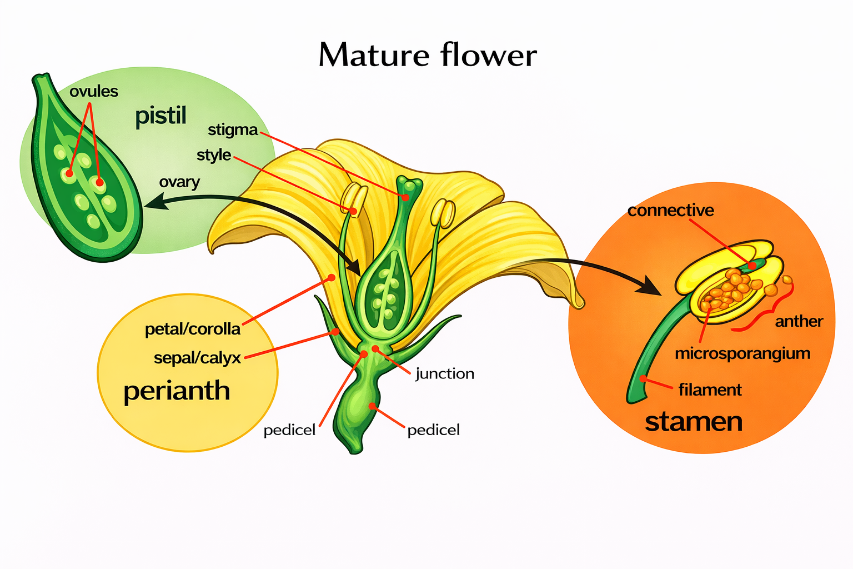
- A stalk called the pedicel. It may be absent in sessile flowers.
- A swollen tip called the thalamus or receptacle.
- Four whorls of floral organs arranged on the thalamus.
- A recognizable floral plan even when some parts are absent or modified.
Parts Of A Flower
Pedicel
The pedicel is the stalk of the flower. If a flower has no stalk, it is called sessile. This becomes relevant when identifying inflorescences and describing flowers in families.
Thalamus (Receptacle)
The thalamus is the swollen end of the pedicel where all floral parts arise. It may be flat, conical, convex, or concave.
The shape of the thalamus becomes important when you study ovary position and floral diagrams.
Four Floral Whorls
A typical flower consists of four concentric whorls, arranged from outside to inside.
- Calyx
- Corolla
- Androecium
- Gynoecium
The first two are accessory whorls, and the last two are essential whorls. NEET often asks which whorls are essential because reproduction depends directly on them.
Calyx
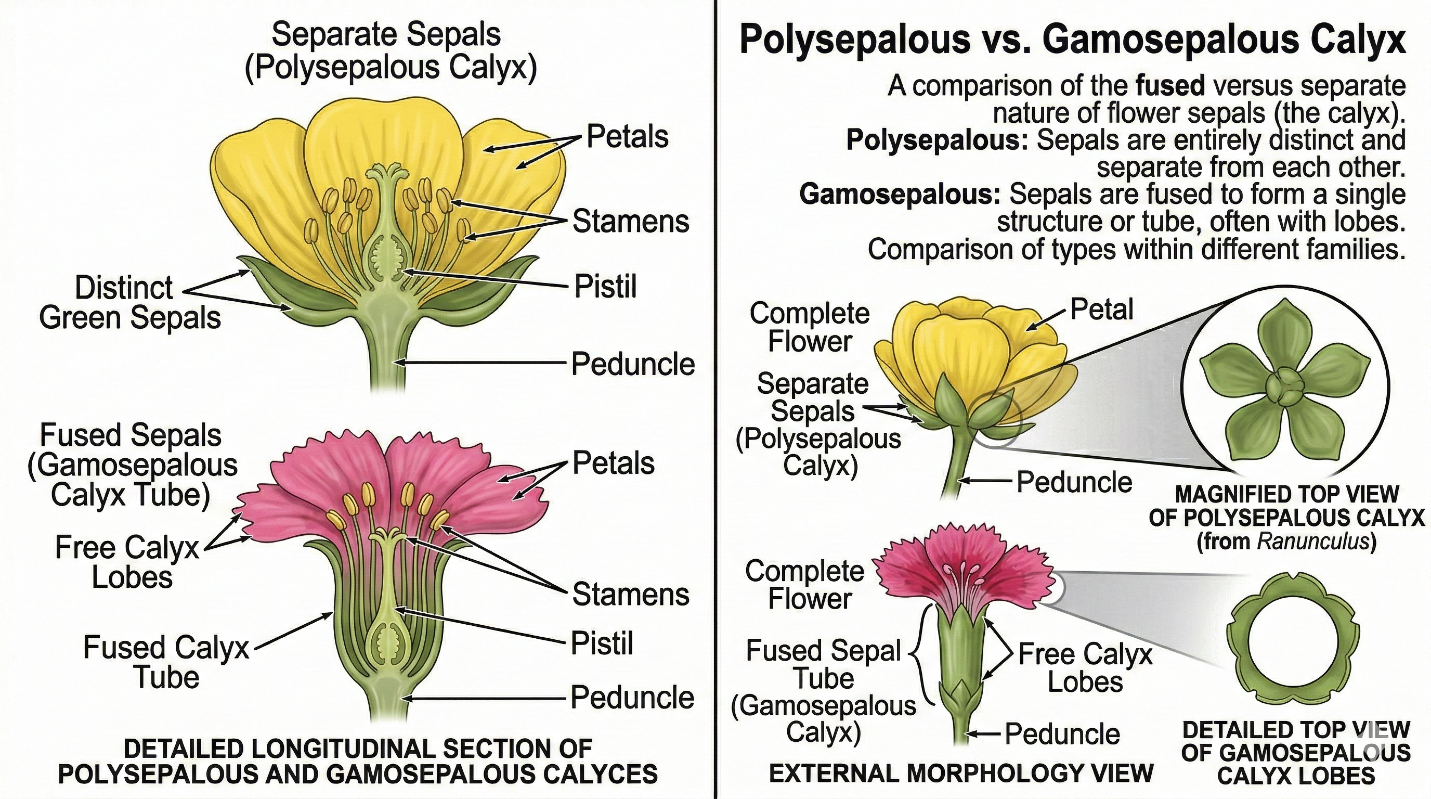
The calyx is the outermost whorl, composed of sepals. Sepals are usually green and leaf-like. Their main function is to protect the flower in the bud stage.
Sepals may be free from each other, called polysepalous, or fused, called gamosepalous.
NEET frequently tests these terms by giving diagrams of flowers and asking whether the sepals are free or fused.
Corolla
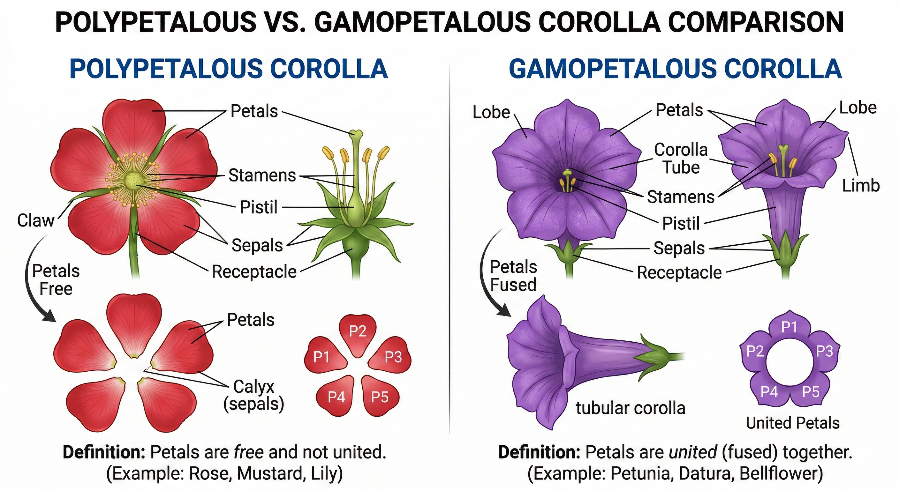
The corolla is composed of petals. Petals are usually brightly coloured and help attract pollinators. They may also be scented or nectar-bearing.
Petals can be free, called polypetalous, or fused, called gamopetalous.
Perianth
In some flowers, sepals and petals are not clearly distinguishable. In such cases, they are collectively called tepals, and the whole whorl is called the perianth.
Example: Lily. NEET often checks this concept because students try to force calyx and corolla even when the flower has tepals.
Androecium
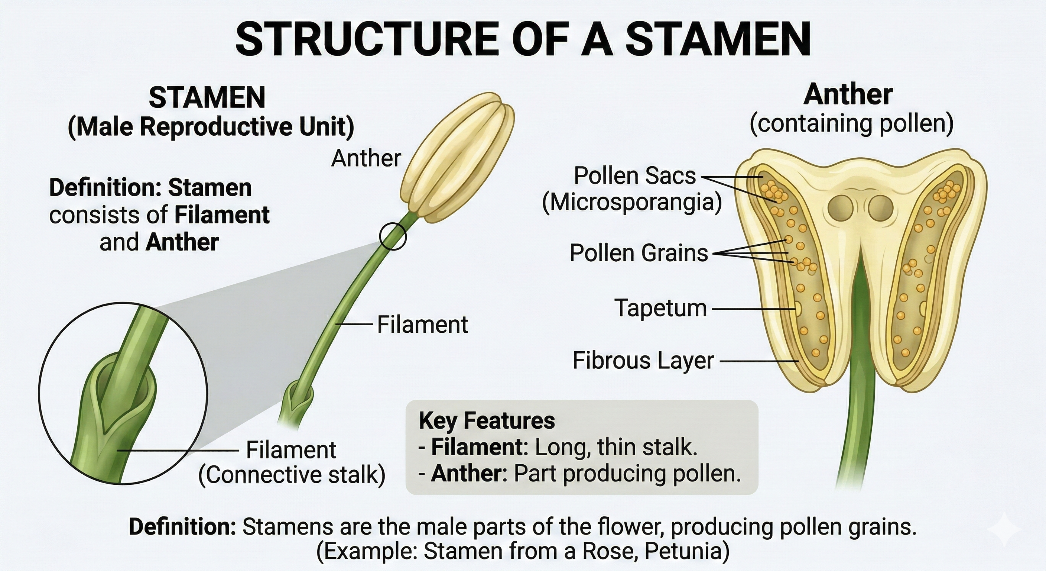
The androecium is the male reproductive whorl, made up of stamens. Each stamen typically has a slender stalk called the filament and a terminal part called the anther. The anther produces pollen grains.
Attachment Of Stamens
Stamens may be attached to petals or the perianth. This attachment pattern is tested in floral families.
- Epipetalous: stamens attached to petals.
- Epiphyllous: stamens attached to perianth.
These terms are more useful later in family descriptions, but NEET occasionally tests them directly.
Cohesion And Adhesion In Androecium
Cohesion refers to fusion among stamens. Adhesion refers to fusion between stamens and other floral parts.
These ideas become relevant when describing conditions like monadelphous or diadelphous later in the chapter. NEET often mixes these terms, so the distinction matters.
Gynoecium
The gynoecium is the female reproductive whorl, made up of one or more carpels. Each carpel has three main parts:
- Stigma, which receives pollen
- Style, which connects stigma to ovary
- Ovary, which contains ovules
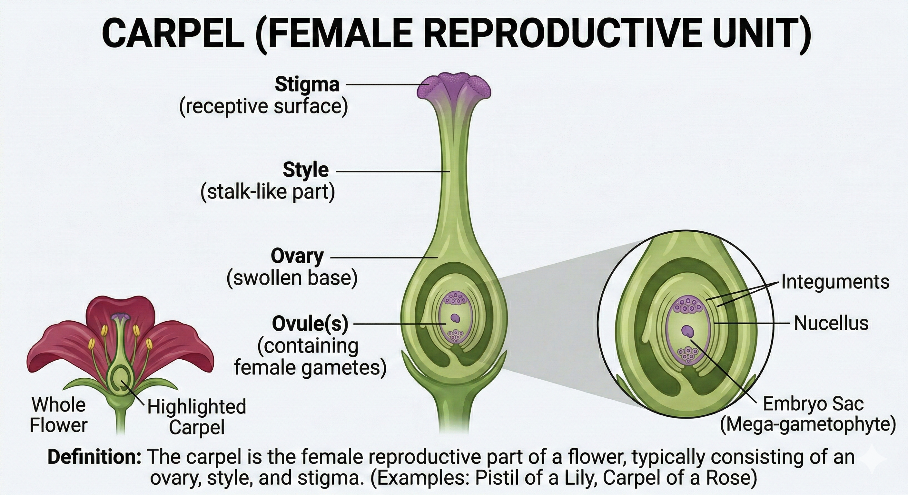
After fertilisation, the ovary develops into the fruit and the ovules develop into seeds. This linkage is very high-yield in NEET.
Monocarpellary And Multicarpellary
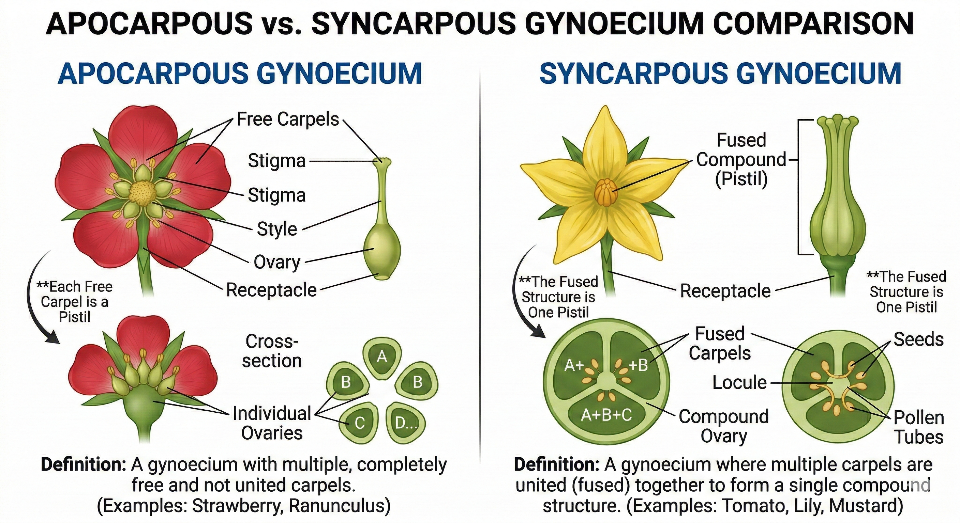
Monocarpellary means the gynoecium has one carpel. Multicarpellary means it has more than one carpel.
In multicarpellary flowers, carpels may be free, called apocarpous, or fused, called syncarpous.
Types Of Flowers Based On Reproductive Organs
Bisexual Flowers
Bisexual flowers contain both androecium and gynoecium.
Unisexual Flowers
Unisexual flowers contain only one reproductive whorl. This is frequently tested in family-based questions.
Symmetry Of Flowers
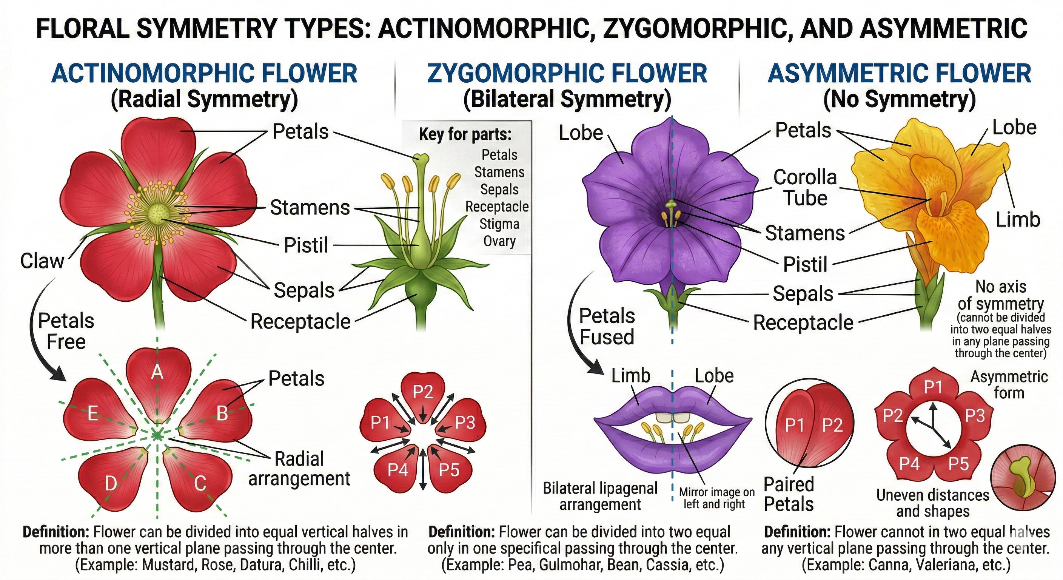
Flower symmetry is a major NEET topic, especially in family identification.
Actinomorphic
Actinomorphic flowers are radially symmetrical. They can be divided into equal halves in multiple planes. Example: Mustard, Datura.
Zygomorphic
Zygomorphic flowers are bilaterally symmetrical. They can be divided into two equal halves in only one plane. Example: Pea, Gulmohar.
Asymmetric
Asymmetric flowers cannot be divided into equal halves by any plane. Example: Canna.
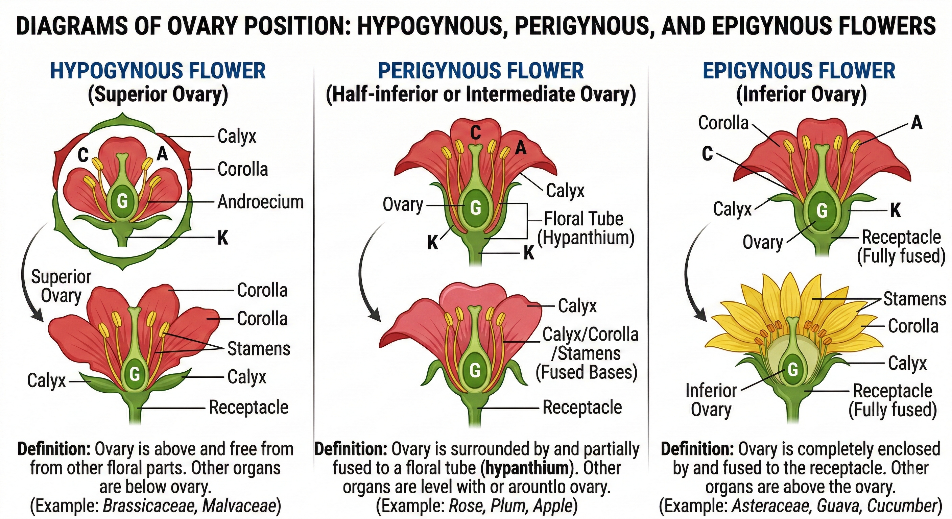
Position Of Ovary
The ovary position depends on the relative placement of the other floral whorls with respect to the ovary.
Hypogynous Flower
The ovary is superior and the other parts arise below the ovary. Example: Mustard, Brinjal.
Perigynous Flower
The ovary is half-inferior and the other parts arise around the ovary. Example: Plum, Rose.
Epigynous Flower
The ovary is inferior and the other parts arise above the ovary. Example: Guava, Cucumber.
NEET very frequently tests these three terms with diagrams, so this comparison must be very clear.
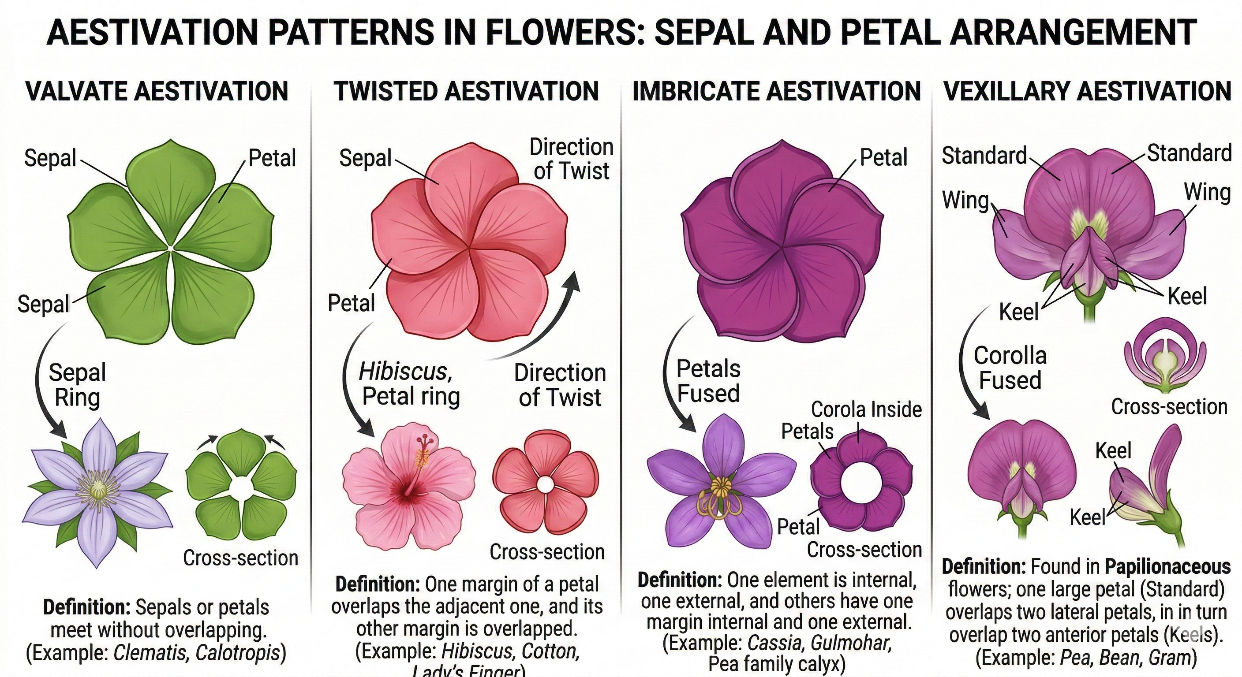
Aestivation
Aestivation refers to the arrangement of sepals or petals in the floral bud.
- Valvate
- Twisted
- Imbricate
- Vexillary
This is heavily tested, especially vexillary aestivation in papilionaceous corolla.